

Trausnitz Castle – Landshut
Trausnitz Castle, a massive building complex that towers above the town of Landshut, was founded in 1204 by Duke Ludwig I, the ‘Kelheimer’. For 250 years this ancestral seat of the Wittelsbachs was the residence and seat of government of the dukes of Lower Bavaria. The ‘Rich Dukes’ of Bavaria-Landshut, Heinrich, Ludwig and Georg, ruling in the 15th century, played a particularly influential part in the castle’s development. Even today, at four-yearly intervals, the town still celebrates the ‘Landshut Wedding’, re-enacting the wedding of Georg, son of Ludwig the Rich, to Hedwig, the daughter of the Polish king, in 1475.
In the 16th century important additions were made to the castle and it acquired some of the attributes of a Renaissance palace. Thus today the exterior of Trausnitz Castle is dominated on the one hand by its medieval buildings such as the almost intact ring of fortifications with its peel towers, gate buildings and sections of the original battlements, as well as the high keep, known as the Wittelsbach Tower. With the magnificent inner courtyard with its arcades, on the other hand, the castle displays its Renaissance heritage.
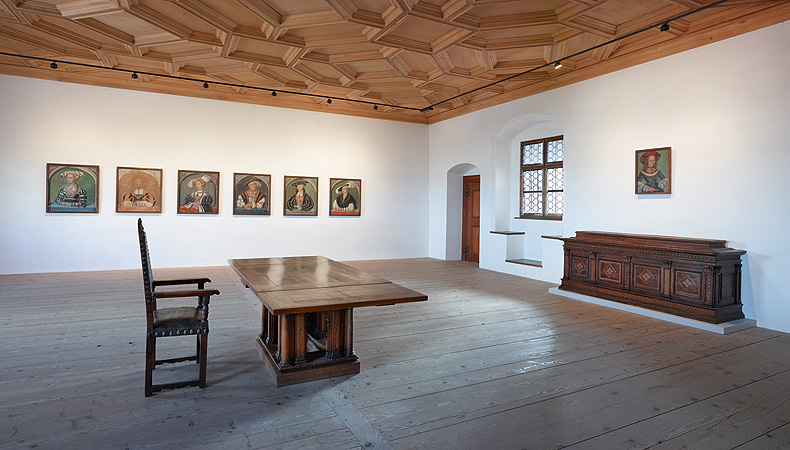
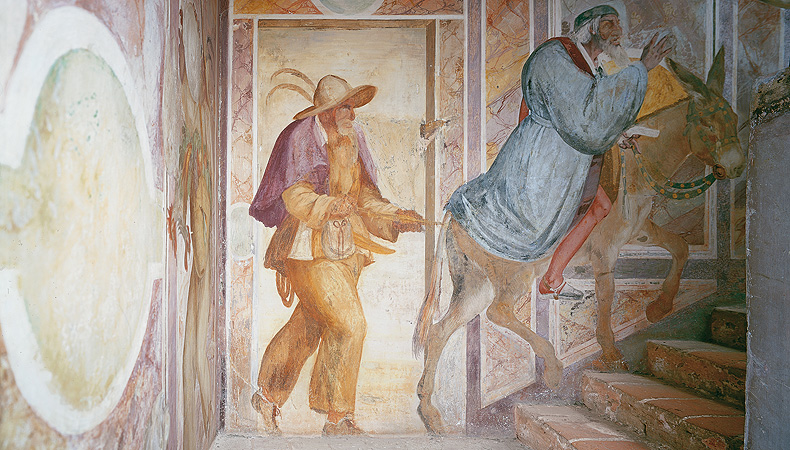
Included in the tour of the castle are medieval halls and the castle chapel with its important sculptures and the winged altarpieces of the Rich Dukes. The Renaissance epoch is represented with vaulted cabinets, panelled rooms and the famous Fools’ Staircase with its monumental scenes from the Italian Commedia dell’arte. One room documents the former splendour of the ‘lodging’ created for King Ludwig II of Bavaria. The tour culminates with a view of the town from the balcony.
The ‘Kunst- und Wunderkammer Burg Trausnitz’ (Chamber of Art and Curiosities), a branch of the Bavarian National Museum, is a collection of 750 exhibits including works of art, treasures from the Orient and curiosities typical of the collections owned by rulers in the Renaissance era.
Address
Burg Trausnitz 168
84036 Landshut
0871 92411-0
Infoline 0871 92411-44
www.burg-trausnitz.de
Opening hours
28 March-September: 9 am-6 pm
October-27 March: 10 am-4 pm
open daily
30 April-2 August 2026:
No guided tours (including special exhibition)
From 3 August 2026:
Monday to Saturday
Visit only with a guided tour (in German; every hour)
Sundays and holidays
No tours; visitors can go around on their own
Closed on: January 1, Shrove Tuesday, December 24/25/31
Guided tours
From 3 August 2026:
Monday to Saturday
Visit only with a guided tour (in German; every hour)
Sundays and holidays
No tours; visitors can go around on their own
In the Chamber of Art and Curiosities there are no regular guided tours.
Admission fees 2026
Trausnitz Castle (including the Chamber of Art and Curiosities):
6 euros regular
5 euros reduced
Children under 18 are admitted free of charge.
Accessibility
Getting here / parking
Landshut
www.bahn.com
Bus number 7 or 7A from 'Altstadt' to 'Kalcherstraße' (way to the castle: ca. 1 km); additional stop on demand from March to October at 'Hofgartenparkplatz'
100 car parking spaces, 4 bus parking spaces available at 'Hofgartenparkplatz' (way to the castle: around 800 m)
Further information
Event rooms at Trausnitz Castle
Service (leaflets, photo/film, links…)
Kunst- und Wunderkammer (Chamber of Art and Curiosities; Branch of the Bavarian National Museum)
Shop
www.kulturgut.de
Burgschänke
Restaurant & Bar
0871 96622977
www.landshut-burgschaenke.de
Administrative office
Burgverwaltung Landshut
Burg Trausnitz 168
84036 Landshut
0871 92411-0
Fax 0871 92411-40
burgverwaltung.landshut@ bsv.bayern.de
www.burg-trausnitz.de
